Data-connected Agents
Agents that query your data instead of inventing it
The layer that connects your models to your systems: tools, permissions and traceability so an agent can read your data platform and act on your applications under control.
The glue between your data and your AI
The problem
- You have an assistant that answers well over documents, but can't query your database or your ERP.
- Every new integration is hand-rolled and ends with credentials pasted into the code.
- There's no traceability: nobody can reconstruct what the agent queried or with which permissions.
- Teams duplicate connectors because there's no shared layer.
What's included
- Design of the agent's tool layer: what it can query, what it can execute and within which limits.
- Connectors to your sources: data platform, operational databases, internal APIs and SaaS.
- MCP servers and reusable tool APIs shared across agents and teams.
- Identity-based permissions: the agent acts with the user's scope, not as a superuser.
- Observability and traces for every call, query and decision the agent makes.
- Guardrails and cost limits per use case.
The same infrastructure discipline, applied to agents
An agent in production is one more distributed system: it needs identity, permissions, observability and cost control. We treat it as such, with the same engineering we apply to operating your cloud.
See Observability & SREHow we work
Discovery
We map which systems the agent needs to touch and what risk each action carries.
Plan & Quote
We design the tool layer and the permission model, with tight scope and a closed price.
Execution
We build the connectors and the traces, validating each tool against real cases before enabling it.
Hand-off & MSP
We leave the layer documented and monitored, ready for other teams to add their own agents on top.
Stack & technologies
AWS Competency
AWS AI Services Competency
The AWS AI Services Competency recognizes our technical expertise and our ability to take AI solutions into production, with real projects and a focus on results.
We combine strategy, data and artificial intelligence to identify opportunities with concrete impact for each business, reduce uncertainty during implementation and turn ideas into scalable solutions.
This competency also complements our experience in AWS migrations, allowing us to support our customers from cloud infrastructure all the way to the implementation of AI solutions.
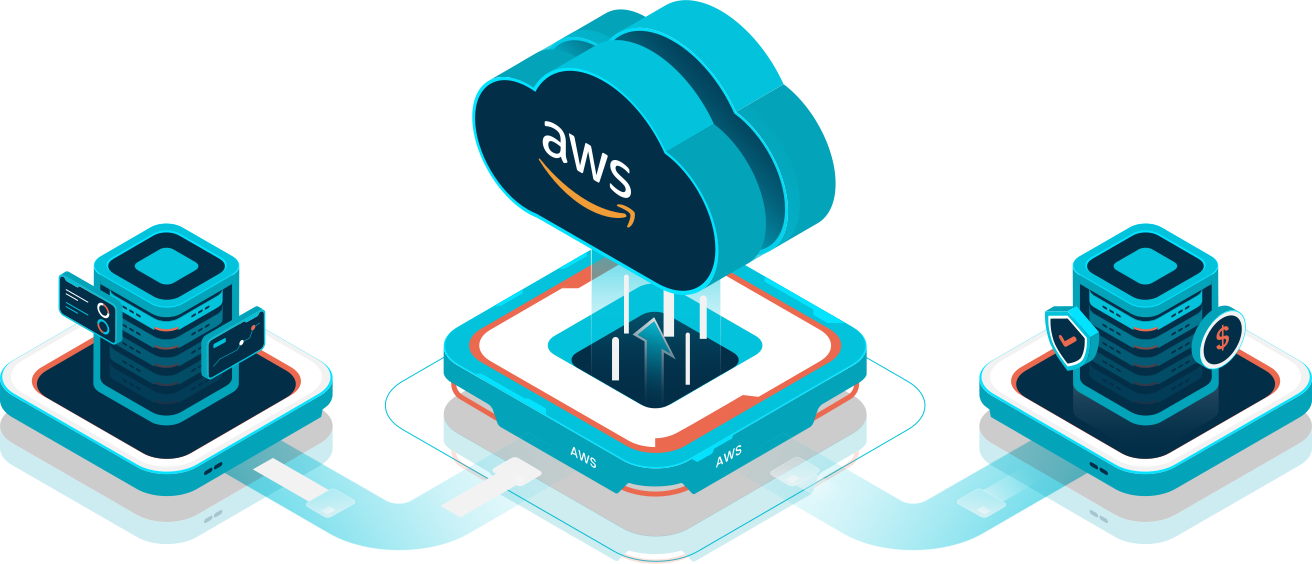

Agents with permissions, limits and traceability
FAQ
How is this different from a chatbot over documents?
A chatbot answers with retrieved text. A connected agent queries systems and executes actions, which demands permissions, limits and traceability for every call.
How do you stop the agent from doing something it shouldn't?
With explicit, narrow tools, identity-based permissions, guardrails and human approval on sensitive actions.
Does it work for several agents or just one?
The layer is designed to be reusable: the same connectors and permissions serve the agents of different teams.
Can the cost be controlled?
Yes, with per-use-case limits and consumption monitoring, following the same FinOps criteria we apply to infrastructure.